Creeps by Night
The Show That Gave Karloff a Home on Radio
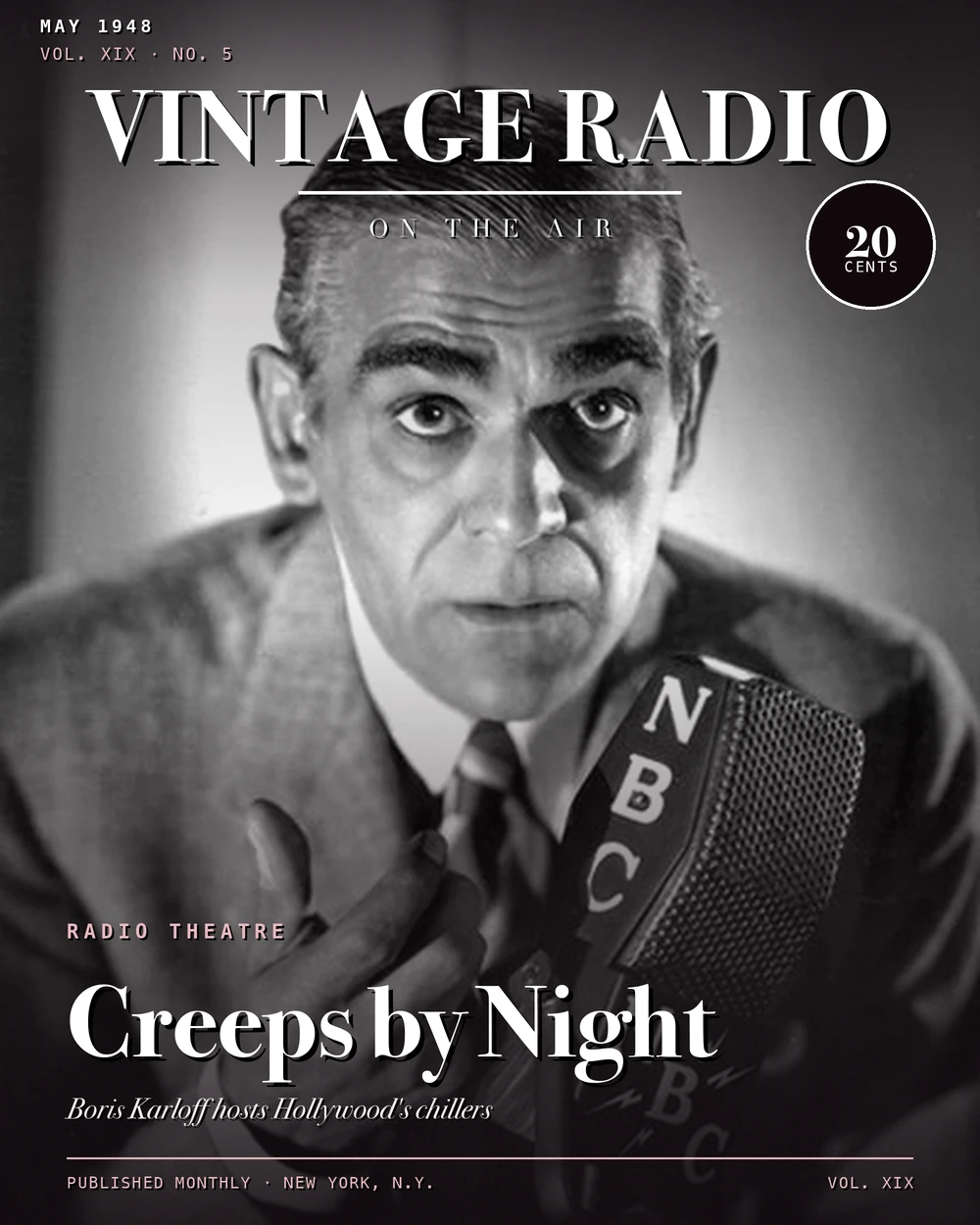
For most of his career before 1944, Boris Karloff — born William Henry Pratt in Dulwich, London — had been a visitor on radio rather than a resident. He'd appeared in Arch Oboler's Lights Out!, most memorably in the episode "Cat Wife," and turned up seven times on Inner Sanctum Mystery starting in 1941. He was always a guest. Creeps by Night, which debuted on the Blue Network on February 15, 1944, changed that. It was the first radio program to give Karloff a full-time role as host, narrator, and star, and for its first twelve episodes it was very much his show.
The format was anthology horror, presenting what a contemporary newspaper brief described as "subtle, psychological chillers." Karloff himself stated the show's theme in his opening remarks each week: "There is no greater mystery than the mystery of the mind." That line wasn't just throat-clearing — the best episodes followed through on it, leaning into dread and unease rather than monsters and gore. The show ran Tuesdays at 10:30 p.m. for thirty minutes, and print advertisements carried a mock health warning urging anyone with heart trouble not to listen, with the station disclaiming "all responsibility for the health of those who insist on hearing this thriller." The organ music that opened each episode was dark and ominous enough to make the warning feel plausible.
A Lineup Worth Noticing
One of the more remarkable things about the program's Hollywood run was the guest list. A Pittsburgh Press item from February 11, 1944 announced that upcoming guests would include Bela Lugosi, Laird Cregar, Peter Lorre, Raymond Massey, and Basil Rathbone — and the show actually delivered. All five appeared, putting Creeps by Night among the very few programs to assemble six major horror film personalities — Karloff, Lugosi, Lorre, Cregar, Massey, and Rathbone — on the same series.
The stories themselves ranged from psychological suspense to supernatural territory. The premiere, "The Voice of Death," followed a widow compelled to commit murders after hearing her dead husband's voice. "The Hunt," aired in May 1944, put Karloff in the role of Loomus Horton on a Louisiana bayou farm in a werewolf story that deliberately left the nature of the "beast" ambiguous. "The Walking Dead," broadcast May 16, 1944, dealt with Haitian workers cursing a French overseer and the zombie-like figure that appeared afterward. "The Final Reckoning" cast Karloff as an innocent convict who learns barbering in prison while plotting revenge against the gangster who framed him. The three writers responsible for these scripts — Gene Wang, Alonzo Dean Cole, and Ruth Fenisong — received no on-air credit during the run.
When the Show Left California
Production moved from Hollywood to New York after May 23, 1944, and the program was never the same. Karloff did not make the move. In his place, the remaining four episodes were hosted by a figure introduced only as "Dr. X" — an anonymous narrator whose identity was reportedly unknown not just to the audience but to other members of the cast. Variety's reviewer was direct about what the device signaled, calling it an "obvious attempt to build up audience interest in a narrator who has little or no public appeal when appearing under his own name." The role is now attributed to at least two different, unidentified performers.
The New York phase brought in a strong radio cast — Jackson Beck, Ed Begley, Everett Sloane, Mary Patton, Juano Hernandez, Abby Lewis, and Gregory Morton were among those heard regularly. Music was handled by Albert Sack and Joseph Stopak. Robert Maxwell produced and Dave Drummond directed. But the ratings that had held up during the Hollywood run fell off sharply once Karloff was gone, and the Blue Network cancelled the program on August 15, 1944 — less than three months after the move east. It didn't help that the network failed to properly promote the show, routinely neglecting to advertise upcoming guest stars or story titles in advance.
What Survived and What Came After
The series ran to 16 known episodes in total. Of those, 7 are known to survive, some of them through AFRS Mystery Playhouse rebroadcasts — the Armed Forces Radio Service edited horror anthology material for overseas troops during the war, stripping original introductions and commercials in the process. The show was also carried in Canada on the Dominion Network of the CBC at 9:30 p.m. and on station CKRC.
The reviews that came in during the Hollywood run were positive. The Showmen's Trade Review columnist who covered "The Strange Burial of Alexander Jordan" — an episode starring Edmund Gwenn — wrote that the production scared the writer "out of our skin." Variety called the same episode "a suspenseful dramatization," adding that the "Script was well written and acted, although ending was fairly obvious." That combination — strong critical reception, capable cast, genuine audience interest — makes the cancellation feel more like a production and promotion failure than a creative one.
For Karloff, the show's short run mattered more than its longevity. The hosting role he developed on Creeps by Night turned out to be a template he returned to repeatedly: an eight-episode summer 1947 revival of Lights Out on ABC Radio using scripts from the show's original creator Wyllis Cooper, the anthology series Starring Boris Karloff on ABC in 1949, and ultimately the NBC television series Thriller, which he hosted from 1960 to 1962. Creeps by Night was where that particular version of Karloff — the authoritative, slightly sinister host who sets the mood and then steps back — first had room to develop.